Grayson Perry and the travel pussy

It’s one part Hugh Hefner to another part Bond this morning, the first time in my life I have spent from waking until late afternoon in a bathrobe. Frustuk in the Capuchin wing of the monastery (those old monks presumably spinning in their graves, perhaps they moved to CERN). High ceilings, last days of Marienbad vibe. I download – buy – Dostoievski, complete works for one pound ninety nine.

It is fantastic to be able to buy and then read the books referenced in a place. In seconds. Perhaps for many the e-book is a modernity too far, but for me – on the road and unable to have a sherpa carry my extensive library – it is perfection.

Dostoievski published The Gamblers in 1866; but reading the novella now on the sun recliner next to the thermal whirligig pool it is as fresh and relevant and contemporary – and as cynical – as an AMC series about Madisson Avenue ad executives.

I whirl and gig in between the duplicitous, tragi-comic chapters. The Gamblers is a pretty savage comic-mode death-job on spa towns. I know, but have no facts, that we British went crazy for German spa in the Victorian Era. I’m pretty sure it was to here, Baden-Baden that William “Vanity Fair” Thackeray brought his chronically depressed wife for – failed – treatment.

Thackeray was the Wayne Rooney of the Victorian Novelists – ballerinas were his WAGs; and he ate like food was going extinct the next day. In one of his travel books, From Cornhill to Grand Cairo, he records a 12 course lunch, more food than I’ve consumed on this trip.

The Gamblers is located in BB, and thematically at the nexus of money, sex, race, Europe, marriage – and gambling. Funny that the “new” post-Bankruptcy B-Baden, seems so similar.

My poolside companions (inside and out) are leathered and German. They fill out those books of games fur uhr upon uhr. I guess they think I am dull for playing on a computer for hours. But it’s digital Dostoievski, so who cares? I start off feeling very white; later very pink.

At five I go back into town, and sit at the cafe which dominates the central crossroads. It’s not anything very special except that yesterday in the basement loos I’ve first seen – shades of Chapman’s Homer, Keats lovers – a “travel pussy.” In a vending machine that in the UK would be full of condomania, are one kind of condom, one “mini vibrator” and two types of artificial vagina. They are doing the Vagina Monologues in Strasbourg in November, but this vagina monologue appeared more about not having to “speak to the hand.” I needed a photograph.

Which is how I get to meet Turner-Prize winning artist, Grayson Perry.

The photographic plan was pretty simple, drink coffee, go for pee, take pix. But then as I am nursing another espresso (up to about eight a day, plus water and wine is my soul liquid intake…) when a slightly prim woman in vaguely punkish spex comes over. I guess because I have been looking over at the outdoor tables near me – where a large group of people dressed for a Hercule Poirot or Jeeves and Wooster shoot are drinking; a couple have wanderweg-ged over to a statue, a funny looking woman. Everyone is speaking English. About a millisecond before Punk Prim asks: “And who are you?” I hear the word “Grayson.”

So my reply to the question mutates. I say: “Actually, I am a critic from Freeze magazine.”
“Fuck, no!”
“That was a joke. I’m doing this walk…” Philippa Perry relaxes and we move into a long conversation about what’s going on – it’s a project for the BBC’s very own Medici Prince, Alan Yentob. The only man who’s nearly killed me at lunch. A long time ago at Kensington Place: I foolishly ate the monk fish, cue green skin, passing out….

Grayson is travelling – as his persona, “Clare” – Bavaria in a customised Harley Davidson bike, with a glass case at the rear where he keeps his teddy bear. The case is miked and camera’d to catch what the locals say. It’s all very high-end conceptual meets dressing up day on a particularly bohemian cycling holiday. Philppa has just published a well-received graphic novel, Couch Fiction; a graphic tale of psychotherapy. I promise to read it, though suspect I’ll have to wait for print, rather than IPAD download.

I meet the director, who asks about my shoes – he’s always had problems. An actress who has just been doing Shakespeare at the Globe; a publisher who wanted to come along. The elderly gentleman and his partner who customised the motorbike and travel with the gang to keep the Harley fine-tuned. Very “Imagine”; very old school BBC, the kind of thing we may have to fight for soon. Lovely, in fact.

We say goodbye and I go back to my Moleskine. Then Grayson comes over and sits with me because he knows how lonely it is travelling alone. He mentions a visit to Japan. He’s just ridden the Nürburgring with teddy. We get somehow onto mountains, church bells – how the English invented winter sports. He’s a friendly, very clever guy. I wish I knew more about his work.

“In the Swiss mountains, and again, more recently, ” I say, “I keep thinking about Casper David –
“- Friedrich,” I know, says Grayson. “I was driving the Nürburgring, and it goes pretty high and I was thinking Friedrich…”
“It’s funny how it took Romanticism to make people ‘like’ mountains.”
“They finally felt safe, felt safety, I think. The mountains weren’t the enemy any more.”

I begin to talk about Matthew Barney and the Slaugen show in Basel.”
“I have a problem with Matthew Barney -” But we never found out what.

Three London Biker-Geezers have arrived at the table. “I’ve got ten pounds says you were on ‘Have I Got News for You?” a couple of weeks ago.”
“Yes I was.”
Big grin – tenners all around. “You were good.”
“And what are you boys doing here?”
“We’re motorbiking Germany.”
“I just did the Nürburgring yesterday.”
“So did I, what time did you do?”
“Oh, it was slow. Where are you all from?”
“Essex.”
“I’m from Chelmsford [also Essex].”

We all get special Victoria Miro Gallery Postcards of the Project. The programme is out next year, 2011 – if the BBC still exists. I tell Philippa about the travel pussy. “We don’t need them,” she says, we’ll all travelling with our fuckees.”

The Travel Pussy is on the right

Later, winding home to the Capuchin Radisson, I stop at a posh bar in the hope of Russians, instead I meet a handsome local couple, Rainer and Renata (say), and they work as executives in one of the really smart hotels here. They’re sharp and fun, and they talk of the long Russian heritage here. Rainer’s just back from Argentina, lived in Chicago a long time. He loves the new bands, Hurts, and Delphic, and they’re both coming here – yes here – shortly. Better than Deep Purple, or Barclay James Harvest.

A bus stops by our table. A – sizeable – Englishman, young jumps out. “Casino?” he shouts. Twice. Nobody says a word. I stand up and give him instructions – straight, right, look out for, well you’ll find it.

“I thought I was back in Bournemouth,” Rainer says. Then I work out that the pair come from the hotel where the 2006 English World Cup Wags stayed. “Oh we loved Posh,” they say. Funny then, that this morning in a very Baden-Baden/Gamblers everything is for sale kind of way, that one WAG’s life, or at least their public personna’s life, has unravelled a little.

In the morning I begin to understand the Englishman and the casino. Tom slept rough the next two nights on the way to Heidelberg. I’m not doing that: it’s a bitch with the wifi. So I walk to the railway station, a two hour plus feat, far away from the old town, past malls and media centres and more casinos. The railway station has been taken over by England football fans. There is a nasty dark menace to the cafes and – yes bars. Everyone is drinking, it is 10am. The England match is in Basel, across the border. I wonder if these guys might have been turned back on an airplane. I don’t speak a word of English, but am so nervous, not speaking, I knock over and break a plastic moulded croissant. The boys just laugh. Two hours later I’m in Heidelberg and experiencing a spectacular time warp. Goodbye Proto Vegas; hello Second Athens.
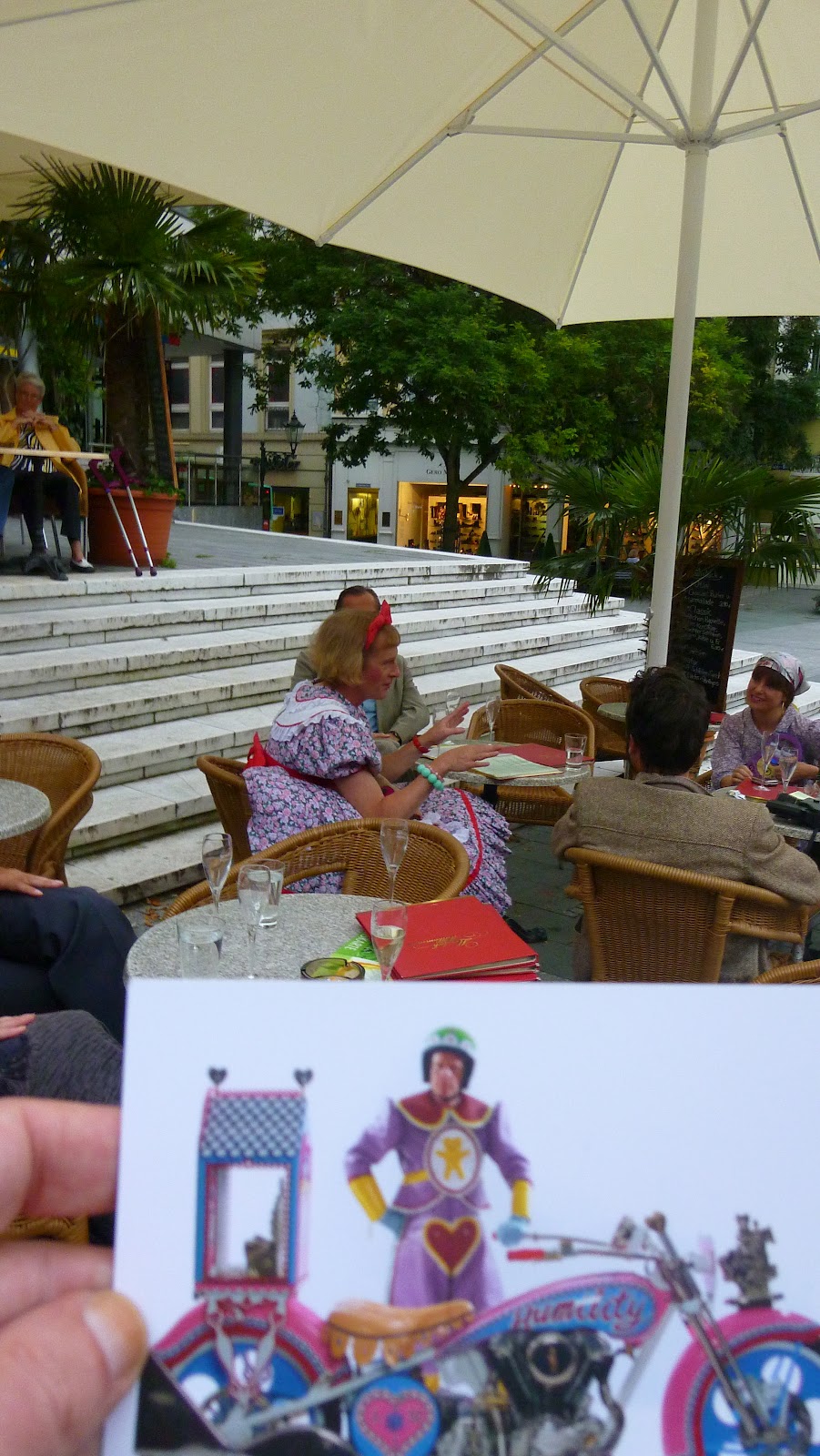
Every biker needs a calling card

Posted in Alan Yentob, Baden-Baden, BBC, Dostoievski, Grayson Perry, Philippa Perry, The Gamblers, Thomas Coryat | Leave a comment

On the Road Road to Baden-Baden

I get good karma kudos at breakfast, as word seems to have spread that I’m a crazy English walker, and not an investment banker with IPAD fashion accessory. Over fruity fruhstuk I ask Dieter about the area around Ziebelhof. He doesn’t go far, 6 kilometres is far enough – to the supermarket to get food for his guests. He’d like to hunt more, to shoot, but it’s busy being a hotelier. A nod from a male and female biker team, good luck.

See you next time, Dieter says. And hey, next time be sensible.

Bring a car.

And I am walking again. Flat, fields of maize; Lichetenau soon enough, a small town, with active Sunday morning services, women priests again, as I’ll find in Heidelberg too. Sun determinedly out, and Baden Baden not too far away – perhaps 20 kilometres.

I should say, perhaps, that despite the casual insouciance of these narratives I am a bad walker: I get lost all the time. Were it not for the compass cum travel guide that is my IPAD, I would by now be close to the Andes. I am really trying to re-invent myself as an accomplished walker, and I can do the distance, and the hills, but whatever nomadic DNA trace that remains has been systematically eradicated by the socialisation processes of my past 51 years.

I can’t use the sun; I have no in-built radar; or even sense of direction. I do – now as a matter of course – ask the way every time I see someone. The problem is that many of these people also have lost the “walkers” perspective. Later, sweaty and very grouchy, I ask a couple how far to Baden Baden. They say 2 kilometres. In the end I walked 18 kilometres further…Not their fault, but an idea of how distance and our sense of it, has mutated. In cities and towns I am getting a feel for the subtle shifts of meaning and mood; even just a hint of Tom’s time – and by this I mean beyond the recognition of buildings present in 1608, I mean the dynamic of church, bell, marketplace, river – media.

Re: grouchy. I haven’t written about this before but travelling alone does encourage talking to oneself, particularly as the day passes by and tiredness is kicking in and the destination still seems miles away. I have a sort of pornographic/offensive/guttural/ vocabulary, the viler the better to ameliorate the paucity of signs, or the bad advice I’ve been given, or just the horribleness of walking on the autobahn, which I’ve had to do again today for a while. I won’t give any examples, wanting to not be banned from blogging, but the screamed oaths are very satisfying.

Yes, lost again today. Wimbush City Limits. But no Ike and Tina. Oh Lord I know I have often lost my way in the Journey of Life, but get me back on fucking track. The Beemers pass at 160 kilometres an hour, the Beemers and Mercs and Porschsters…and I’m gingerly edging the tall grass alongside, wondering when I will see a sign for cyclists or walkers. When the sign won’t say: Frankfurt 200 kilometres.

The first chills of autumn this afternoon, a little bite to the air. In successive conversations in what I believe to be the hinterlands of Baden-Baden I am told 2k, 2-4k, 5-7k, then 10k. Ten minutes, thirty.

I was three hours and 18 kilometres away still. When I leave Baden-Baden by rail, Tommy sleeping rough for two days before Heidelberg, it takes me three hours to walk, then find, the station – from the old town. Baden-Baden IS Los Angeles.

Crossed with Las Vegas. Or rather Saratoga Springs circa 1955 – when Ian Fleming visited (read Live and Let Die…).

There isn’t a sign that says Baden-Baden ever on my walk there. I encircle, suburb, cut-through, turn back. Find a park – even the Rhine. But old Baden-Baden?

I really do stagger into town, Brokeback Digerati. I walk straight into the first hotel I see, a Radisson, far more upmarket than anything I’ve stayed in before. It is remarkably cheap, given that it has the full monty of thermal whiizzy whirligig stuff. And it was a Capuchin monastery in 1608…oh bingo. It is huge and fin de siecle-ly. I sleep, then go to buy some swimming trunks for the whirlpool thingy. The only ones in the hotel shop are 85 euros. And it is Sunday. I can wait.

Opposite the casino in the showy-off park, a temporary stage. It is the last night of the racing meet, and as the spring meet was cancelled because of bankruptcy, the town is happy. A band called – oh something grim, actually it is Groovin’ Affairs – are knocking out Relight My Fire, Sweet Dreams, Tina/Celene, 80s….80s….80s…

The audience is my age, my people, only with less preposterous haircuts. They fist pump and sing and remember when they were young. A daughter carries out her drunk Russian mom at about 9.40. The curse of casino towns, I guess. I saw this before in Bad Ragatz.

Porsches and Ferraris are not unknown here. And there is a sense, only heightened tomorrow when I’ll read Dostoievski’s The Gambler, set here, that everything – everything – is for sale.

The local brothels take out page adverts in the local tourist literature, here at the Villa d’Fellatio we offer…blah blah. Very blatant, very part of the package. My hotel is part of the Royal Spas of Europe.

And Wayne Rooney has, my IPAD tells, just got caught in the Manchester version of the Villa d’Fellatio.

Now there is a surprise. The bar in the casino, recommended by my hotel, is probably the best example of 1970s sauna chic seen this side of a white flared-jean Belmondo policier. It is truly the grimmest place on earth. I last 3.6 seconds and retire to a MacDonalds for coffee.

It is the only revolutionary act I can think of. Tomorrow: more Russians, Grayson Perry – yay – and tales of the Wags circa 2006….

Posted in Baden-Baden, Casino, Dostoievski, Thomas Coryat | Leave a comment

Into Germany, leaving the Alsatians

The walking out of Strasbourg dismantles the theories of “tiny” spatial differences somewhat, but only because I can’t knock on doors and check out the Biedermanns in their many forms in the massive mansion blocks. But, things change again long before I’ve left the old town canals. There’s the “plage” boat cafe disco things that complement the canal cruises I’ve stayed well clear of.

The University, loving it’s students, proclaims a large poster. Big wide Haussmann streets, shops not so frequent, shiny cars; then the Council of Europe and all those flags, quiet today, Saturday. Warm too. I zig through the Orangerie, pass the roller skaters and couples and boaters, and a lakeside cafe with a battalion of purple pool tables, as though in wait of the artist now known as Prince again

The other side of the park; suburbia, a turn and I am on the canal – well the Rhine, actually. Houseboats, swans, powerboats, and the inkling of heavy industry. A few wrong turnings and I’m peeing under a bridge at a dead end, a hidden spot, with a large Che graffiti and half a dozen beer cans.

Scramble back, and the industry starts riverside. Large wide low barges. A tow path for bikers. But first a long stretch of Berlin-style Checkpoint Charley wasteland – it is the route – that I walk in the sun alone. The Spy Who Came in from the Hot.

To my left a park with huge warnings about toxic waste and nuclear power, so maybe not. Then the walk. Five hours, straight. By the river, jealous of the power boats; even the container barges. The cyclists pass in singles, pairs and groups. I smile at each. But five hours later I am very tired, and Lichtenau, my destination, seems hours away yet. At one of those border restaurants (with added tourist office) I slump to be entertained by a waiter who speaks about a hundred languages. The tourist office says that Lichtenau is out of her jurisdiction, and books me into Ziegelhof – still Germany. Only two hours walk, she says – though she phones to warn the hotel I’ll be, er, late.

Across the river; an autobahn, and a pit stop at a petrol station for ice-tea and chocolate reserves for later. Lost path, lost river. IPAD says go sort of 45 degrees. I ask: down there, past the lake and then the side of the village. Easy after that.

Long shadows now, and a punishing day already. I walk past a cement factory, and then the lake. The cars above are crashing past at German speeds. Into a small forest. A picnic, 20 people.

It isn’t a picnic. It is three of four sets of Roma families, cooking rough. Out in the wild. They don’t look at me, don’t acknowledge. It is like a scene from a war; a scene of exile. I wonder if they have come over from France because of the French government laws. I feel terrible.

I take the village cut though. Past the factory with the long low wire fences. At about 6.30 as the sun is beginning to set and the shadows grow ever longer I turn to see two alsatian dogs, one black, one white, running at me from 200 metres. I genuinely think I am going to die. In a somewhat pathetic manner I cower.

They don’t jump. Just go insane about four feet from me.

I turn around and walk through the village, and then another; fields playing Van Gogh tricks; Kiefer tricks. Rain. Lost. IPAD not helpful. Great sunset, another village, but not Ziebelhof. Nobody’s heard of it.

A village, deserted, dead. And at its centre, The Pussy Cat Strip Club. Last used 450 millennia ago, it seems. Out of the mists along a track a 15 year old girl on roller skates. Ziebelhof, I say. Never heard of it. I’ll go look.

She zooms off, a vision of wonder. Twenty heavy minutes later she returns. I’ve found it, keep going, not so far, stay to the road.

And with a sweet smile she is gone. The Gods have smiled on me for liking roller skaters, ever since early Switzerland. The visions have been wonderful today; the industry lurking just outside Strasbourg, Basel-esquely. The long stretches of river, very like, only far longer, that stretch of the Thames at Richmond which Turner and Wordsworth loved. I wonder if Tom, who knew that part of the Thames what with one John Dee or King or Queen or Prince – or another, thought the same thing. There’s no doubting that we talked, Tom and I, for a minute during that part of the walk.

Dark now and Ziebelhof, five miles (now the signs tell me) from Lichtenau, where Tom stayed. The town is actually a motel, and two houses. Inside the motel there’s a bunch of domestic bikers having dinner. Dieter, the owner, is an ex East German policeman, 28 years. “And then I had to start working,” he says. He loves my IPAD; shows me his IPhone apps – the favourite? An app for streaming country music.

German country music from the 1970s.

What about the Pussy Cat Club? I ask Dieter. Ach, closed forever.
“Open, in fact,” says a man who lives two weeks a month here, doing something with the electricity. “Even the coffee starts at 8 Euros.”

I turn on the television and doze over wifi. Then some channel launches Help, by The Beatles. In German. I burst uncontrollably into tears. Then, in the post-modern way, post this fact on Facebook.

In the morning Dieter tells me about the “community”. But that really is for tomorrow’s walk; and my first real full day with German signage. Or indeed, its absence.

Posted in Uncategorized | Leave a comment

On Marrying Elvis Presley

There’s a courtyard view from my hotel room; not looking towards the cathedral but away to another space I’ve not been. Leaving by the front entrance is a confrontational experience, fighting the many who sit in the cafes and restaurants, those fleeing the cathedral, the lost, the hawkers with head-umbrellas: they cluster. And eat cheese. Buy hats.

But here from my window is an almost empty courtyard below. In fact, as I GPS, it’s in between the cathedral square and the street I’ve temporarily named rue de Aldolfo Domingez, as his fashion is sold there, Hermes is just up that street. It is in fact the Rue de Veil L’hopital.

I wind to the courtyard, and find a brasserie. The customers are different, local, tied up with reading the local paper, or a book, gossiping about something. We are twenty metres from the storming of the Cathedral and we could be in another country. It is a Friday; school’s out by lunchtime and there are lots of kids smooching canal side, hanging outside the school gates. But here is contentment, of the local kind.

It is a very different mood in term time; I assume this only increases when the undergraduates, Erasmuses (more on them later), and politicians return for duty. At each turn away the alleys and streets and boulevards – but mostly the alleys – bring a new and more variegated community. The longer I travel the easier, perhaps, to sense difference. We are certainly, if temporarily, back in France. Though Strasbourg is “particularly” French, in the same way that Rennes and Cassis are particular. There is a sense of hermetic openness. Roman once, of course. Alsace now, more than most.

It seems, thus, ironic, that next week the Strasbourg parliament will debate, with vigour, the position of the French government in relation to its “Roma”. The newspapers here – and all over the world – are full of the story. The sniff of exile, of the Rhine trail, of Guttenberg, who worked here, is all about. What is absent is the sense of the political; the people who make Human Rights Law. Who fight governments over Roma deportations. “They all live in the big apartments around the Orangerie,” Jim – or Jules – said last night. “You don’t see them.” And it is true that the old part of town, which can seem many things, never feels like Brussels sur mer; or Westminster. Because it is Friday, perhaps, the shops and every cafe and bar hum from midday, at the centre, at the periphery, along the canals and tucked away in courtyards. Hum with locality. Not tourism.

There is a lot of middle aged snogging – tongues and all. This seems quite strange to an Englander. Especially at my hideaway local brasserie where a couple not so much younger than me, let’s say maximum ten years, are nipple-tweaking and tongue-wrestling over a couple of espressos. This doesn’t happen in the Columbus Circle Starbucks. My protestant puritanism, had I got any, would be shaken.

Later I ask the actresses about this. Binoche 1 says: “If you have it, you flaunt it, it’s common here.” What I’m – distantly – getting closer to is a sense of the smallness that cities once possessed, not exactly the smallness of Tom’s Strasbourg, but the idea of the feet – metres – that change the social construction of “place”. Interesting as I think back to those amazing north Italian towns, the Cremonas and Mantuas of the first trip, that I didn’t think in this way: I thought about towns as entities, with commonalities. Now I begin to think about multiple entities with overlapping communities. This may be wrong; but no wronger, I suspect than the the lazy Baslers are different from Zurich people discussions of a few nights ago. I eat well for lunch, cordon bleu veal: tomorrow and the next day are country walking towards Baden Baden, and I don’t know what to expect. France to Germany too…

At the roof top cafe of the modern art gallery I am feeling a little underwhelmed, though the nineteenth century landscapes I’ve seen, betwixt a bunch of sculptural installations that revealed not much, make sense. In fact I’ve found my entire art aesthetic, other than Barney, growing old and non-Italianate, northern in fact. There is plenty of torture and pain in the cathedral museum. It does increasingly make sense.

The wide shopping boulevards, pedestrian normally, do have a transcendent blandness, but where do they not? It is the average cafes and bars you judge, by attempting a kind of process that absents first rich tourists, then other tourists, bikers-by, then…well, whoever else doesn’t seem appropriate. I’m trying a kind of unrecognizing. I think about Jim last night, his returning to the scenes of a broken love affair, trying to ignite a new one. As though, what? As though it is geography that creates the right environment. I think too of Barney’s show, the “lines of restraint” he feels are embeddied and embodied in us all.

I met a black kid last night somewhere between Il Cherche Tourjours and Jules et Jim’s Most Horrible Date. He had the most fantastic English accent, somewhere between a BBC newscaster and, say, the mottled mockney of Tony Balir. He looks like a young Hendrix and rides a mountain bike. He’s started speaking because he heard me, and he “loves speaking English.”

Where did you live in England? I ask, expecting a narrative of embassies and fee-paying schools and bitter nights on the training field. Instead: “I was just talking to English people, online, voice-chat, when I was gaming. Such a cool accent. No, not World of Warcraft, but Counterstrike.” He’s a musician too, but “it’s really hard to be a professional musician these days.” Later it becomes clear he’s studying at the most prestigious place – well I think it was Environmental science and how to save the world, or something similar. He looks like he might.

It’s mid afternoon, I’ve trekked my culture, and realised that the first leg, three years ago, in which I covered everything each city or town had created, was a Tom Trip in my pursuit of the constructed, which took me over kilometres of urban spaces but often left me exhausted for the “walks” and so these were often “augmented” by – no cars – transport, was a very different affair. Now I’ve walked as much as Tom, for two weeks, and he, despite his five week break in Venice (come on, he must have been a spy), was really pounding it out and doing his churchgoing – and in the intellectual centres, having the conversations. We’ve lost a little of curiosity stamina, I think.

This morning my hotel front-desk Penelope has written me an Odyssean list of cafes and bars that locals use. BTW only in France could the monthly glossy travel magazine be named Odysse. So I’ve checked out a coffee shop, and the old Irish bar, but it was blazer-heavy even if only metaphorically. I’m double-expresso-ing at the Bar Exile, on Rue de L’Air and I’m thinking, not nodal like the behemoths of Petty France, or the Cafe Broglie; the machines of the Cathedral square. Yet it is local.

Later still, but early enough, Jeannette et les Cycleux. I almost missed it. This is a cafe right opposite Le Cloche au Fromage where we’ve eaten cheese in spectacular lunches, I mean spectacular. This is a city of cycles and limos, I write. Because fifteen feet from Le Cloche, Jeanette’s is another canton – with everything that this means. Unless you miss it, and its meaning. Which is easy to do. Here pearls and neck-tatts, crown-jewel fingers and harem pants all sit happily. I am beginning to see in other ways, perhaps.

I’m talking to one of chefs, who has just finished for the day. She’s telling me about the local products she’s sourced for the charcuterie, and about the Alsace bio-tech valley, from here to Basel is like a biological Silicon valley. She’s helping to shape ideas about Alsace in relation to France, and German; suggesting the traditions and the laws are different from both. Her boyfriend, who will appear soon, is metis, mixed raced. A man, a DJ, from the Caribbean, French father, Caribbean mother. He wants to talk string and big bang and a new unifying theory called “E8” – I still haven’t looked it up. “The spirit is different when it is white fathers, black mothers; rather than the other way around…” Mahta says, the tiny differences that mean a lot.

In Germany it will be easier to meet people Mahta says, “image is not so important.” She’s stopped going skiing – it is far too dangerous, I’d rather walk the mountains. And Florian just didn’t get the snow ski climb thing.

I’ve learnt in Chur that, of course the English invented all that alpine adventure stuff in the nineteenth century, but that’s another story. Although one that tells an interesting story about us – English – and our confused relationship to the Alps; to Germany too. Not so long ago it was a favoured tourist destination.

Mahta’s father, a Swiss, loves the ritual of the ski.

Rosalind sits down and asks about media jobs in London. I am trying to work out why. In fact her story is the story of travel and love. She was in New York a while back, on her own. There was a boy in a (famous) book shop, the (ah ha) section. She saw; two days later they kissed; two more no need for the Harry/Sally Thesis…and then she must come home, on Thursday. That day Eyjafjallajökull went up in Iceland. Thus: two more weeks in Brooklyn….Now they are moving to London…

Rosalind tells the story of the cafe’s name. In Alsace in the 1960s when boys didn’t have cars, they had motorbikes, then as now, there was always The Girl. To try and impress her they would buff and customise their machines, so that in the coffee bar, the cafe, The Girl would notice. They would be The One. Except for one thing: The Girl is in love with Elvis Presley, and wants to move to America. (There was, I feel, a similar mythos around Julie Christie’s character in Billy Liar. And didn’t she end up on the train to London…)

Thus, the iconography of the rooms inside, bikes half embedded in the walls, photo images of French girls in cowboy shirts. It’s very fine. “And that,” I ask Rosalind, “is the story of Alsace girls in the 1960s?”

“No, that’s the story of France now.”

Mahta asks me to remember that the Swiss are famous for mercenary armies; the Swiss guard at the Vatican…but I can’t now remember why. Also the toleration that allowed for Dominicans, and Jews to settle. (I note that I must check my history here; though later walking through the newer town closer to the EU buildings on a Friday night, I see a lot of Jewish families on their way to a sabbath service, or a Shabbas dinner).

Mahta and Florian are laid-back; bereft of the anxiety that can surround some here, those that critique the il cherche tourjours mentality. Those that get over-Proustian and weepy in old bars. There’s a conversation going on behind me in English, though none of participants are English, it ranges over albums, tracks, computer games, festivals, arenas, DVDs.

When I was a teenager, travelling europe, the lingua-franca was the cod conversation about liking Pink Floyd; twenty five years later in Eastern Europe this had evolved to Radiohead. I wondered if I was in the midst of one of this meme’s new pan-European moments. But when their dates, The Binoches, arrive I suspect I’ve stumbled onto a Jean Luc Godard casting, circa 1962. The roll-up cigarettes, the leather, the conversations about Moliere, Marivaux; learning about the word beuark. The hard years in the conservatoire, making it or not as an actress; the curiously interlinked world of the three French film production companies that get grants from the French government. Beart’s botox – she now looks like a duck (there are other allegations, but the English laws of libel, even online)…. The Cigogne, the Bird of Alsace, “if you don’t see one flying just go to the tourist shops and ask to see a plate. The drink of the evening: rose pamplemousse. A local speciality.

A Strasbourg girl with a perfect English accent, who’s dating the bass player of a local band – more Hives than Strokes, very Arktik Munkee – that just toured the Baltics, and also did a gig in the Hawley Arms in London, maybe. but certainly after a Chinese punk act that all wore dresses, starts talking to me about translation. She looks like a young Wuthering Heights Kate Bush. “But I don’t av the ears,” she says.I mean perfect Nrf lundon. Where were you born?

Here.

The accent is amazing.

I met an old Etonian on my Erasmus year in Berlin. His family had the whole thing, the “cottage” next to the main house, the chapel, the Porsche in the drive but no money, the strict no-tears rule when the dog died. They hated me, obviously. ‘He’ asked to delete me from his Facebook friends recently, because “he didn’t like reading French in his news feed.” The Binoches are rehearsing for a play, Sunday. Fables, Marivaux…will be fun. Binoche 1 played a punk on TV; Binoche 2 has done a film and dates a harpist, Binoche 3 is going to Brussels to study Arts Administration.

And then the casting is over. The lights are killed. The cathedral is still there. And in about six hours I have to walk into Germany, to Lichtenau – which is currently foxing the GMApp on the IPAD.

I’ll get there. I’m just not sure how to edit tonight’s movie to make it look like Band a Part.

Posted in Uncategorized | Leave a comment

Strasbourg (1) The Spaces in Between

It’s warm in Strasbourg, the last days of real summer. Around the cathedral square and along the canals of the old city an influx of visitors are consuming. Wine, cheese, culture. More cheese. The flow around the cathedral is relentless, bus tours stop over for headphone commentary reconnaissances. Leather Road Warriors, bikers on their way from or to Milan or Paris, devil may care alpine crossings, pull over, turn off their machines and take a beer while they, at least look at, the amazing cathedral facade. Like a steep, sheer, giant Hindu carving, a supra-elaborate series of narratives.

The facade is stories, media. At 10 in the evening there is a crappy Queen-Concert light show; one might expect Brian May to pop up at the Quasimodo level and windmill arm a power chord. But, even so, the nooks and crannies are fill of tales.

I’m staying in the old town, right on the square. For some reason, perhaps it is the daily stampede around these streets, its easy to get a room. It may be different next week, when the politicians are back with their caravanserai of lobbyists and webmeisters and ‘friends’. Who knows? I was here very recently with Portia: we ate the fine food, and made wine-tasting trips to Colmar, not so far away down the Alsace road. We hung in the French Quarter, relaxed on the roof-top cafe at the Modern Art Museum, the Musée d’Art Moderne et Contemporain de Strasbourg, played backgammon all over town, and generally had one of those adult – kids with their dad – kind of holidays.

This time it was the same, but different. I know to visit the cathedral early; to avoid the presentation about the Strasbourg astronomical clock in the Cathédrale Notre-Dame, I know to miss the tour-party dinner places; to not worry about exploring the arena around the EU. Tom was old town – my mantra – so I stay there, and wander there. Last time we got lost often in Strasbourg and I wasn’t sure why. I wanted to know.

My thesis now is that we hadn’t grasped the scale of the old town; by which I don’t mean the considerable size, or the constant closeness to a canal, but to what – I am forced to call in a Rory Stewart echo – the Spaces in Between. Leaving the cathedral square north, south, east and west reveals almost different countries: if you are looking carefully. Different countries, that is, of experience.

It is in Strasbourg that I begin to appreciate the fine detail of distance, not just in the grand architectural lines of the cathedral, the ringing effect of the canals; the spectre of “otherness” somewhere close on the big boulevards that lead to the EU buildings, but in something else. The detail of social distance. In the same way that Basel and Barney helped me to, in a small way, take the Kunsthaus out of the art I consumed, so here I began to try and imagine the grand, but small, town Tom visited. He loved the clock, obviously: the cathedral was a tourist attraction long before his visit. I’ll write about the clock and “time” separately, later, for now just in passing.

The social distance then, and in fact now, between the cathedral square, and the next, and the French quarter – not really five minutes away, is important. Cities as villages, and globalised in their way, then and now. The cathedral I must escape, because it dominates, an Eiffel of its time – the tallest spires in the “world”, until Cologne cathedral’s grand scheme was completed, finally, in the nineteenth century.

Inside, first, and the famous astrological clock. Impossible, in my era of GPS’d IPAD to imagine the impact of a machine that combines world times with a figurine march-past of symbols, overlooked by death. It is very different, this “northern” worldview.

So many media, then. The arrivals, and city gates; the central square and the imposing, competitive, spires. Bells, the higher the longer they echo; the sun overhead. High above Heidelberg in a few days time, walking my “philosopheweg” for the third time, following not Tom, but Goethe, Schelling, and maybe even Hanah Arendt’s footsteps, I listen to the cathedral bells echoing down the Rhine valley, travelling as far – well, as far as “safety.”

I try and imagine Strasbourg cathedral’s media reach. When there was no new town; no court of Human Rights; and no hinterland.

Today every cafe and bar is full, noisy with transience. From the cafes to the north of the cathedral to the Irish pubs near the University, to the Django-jazz bars of the French quarter.

I am at the Beer Academy, on the edges of the “French” part of town. We are, I should remind us, “in” France, though this is, as the history museum so brilliantly and practically demonstrates (models of the armour from 1600 to wear, pull-out drawers with posters, explanations of “Argentina” – the Romans’ name for Strasbourg, it being the tax collecting centre) a city with a complex paternity. I’m in the beer academy because it is slightly off kilter from the Django bars, and it is opposite a tattoo parlour, and I am – since Chur, and particularly since the revelations of both Barney and the “tortured” art of Basel, somewhat obsessed with both the “mark” and with “pain”.

I sit and write for hours in the Moleskine, a new one, dutifully found in what appears to be a religious bookshop (I didn’t ask). It’s quite late now, still writing, Go outside for a ciggy. when I return the table in front of me, we’re in small pew style seating, is amused. I start writing again. The relation of here to Basel, the French thing. the Jewish tradition. The hermeneutics of the amazing cathedral. I am in Alsace, that’s the thing; betwixt in the real sense.

“Il cherche,” says one of the boozed guys in front of me.
“Il cherche, tourjours,” says another, surlier guy. Boozed up aussi. Boy Laughing, a la Anglais.

I think about this for a moment, and don’t like my moment. “Yes indeed,” I say, my first words to the table in front of me. “I do cherche tourjours. It makes life interesting.”

There is an uneasy silence. Boozy Guys move into a more aggressive mode. We are, as usual, saved by a woman, the woman at their table. She translates, I explain about Tom, the walk, etc.

“”Keep searching,” I say as I leave for, almost, home. I’m not sure if the message got through.

So it is 3am in the morning and I am acting as a kind of marriage guidance counsellor to a young, handsome, Strasbourg couple, if we accept the slight detour from the Truffaut original, lets call the girl Jules and the boy Jim. I know…

They look the perfect couple, young, talking happily, together at 3am without seeming like a late night conjunction, fluent. We’re outside, they approach. “We have a question for you,” the boy says, let’s call him Jim.

“Can a man and a woman have a friendship, be friends, without sex? Without them at least wanting to have sex with each other?”

Ah. The much discussed Crystal-Ryan Doctoral Thesis from 1989. When, er, Harry faire la connaissance de Sally. Hope that is vaguely right.

Well of course, I say. I ask about this late night dive, who’s here, why it has the kinds of people it does…the usual, all bars of this kind have their rationale. Jules smiles broadly at my reply; Jim is not so happy. I think we understand the – universal – situation. I explain why I am here, my walk, the search for whatever it is, “Europe” I suppose. The old Europe I knew and this new hybrid. I tell Jules et Jim about “Il cherche tourjours.” I’m rather pleased with it, an epithet suitable to sit alongside my own current tombstone request: Quick Wit, Slow Fuck (but in Latin, of course, so as no sensibilities could possibly be upset). Jules laughs; Jim says: I think I can explain what they were really saying.

Ah.

The young man is saying you are a homo-sesschual (there is a long phlegmy, squelchy emphasis on the middle syllable that somehow reminds me of the name, Aschenbach, and thus ashtrays, in Death in Venice – I tell neither Jules nor Jim). I see, how interesting. Later I explain Beat’s idea about finding the uber bar and watching the world go by, I explain that I’ve been doing that in Strasbourg.

Like where? says Jim. I quote Beat, Paris. I suggest the Marais, where people watching is fabulous.
“Famously homo-sesschual,” says Jim. I’m getting bored now.

We walk back to the cathedral square without Jules, she’s gone home (naturally). I hear the stories about the breakdown, the Proustian moments in the bar we’ve been in, where Jim cried because his last affair failed, and Jules saw, thus emasculating Jim. The switch from his academic career to being a baker; then back. Jim looks at the illuminated facade of the cathedral. I could tell stories about this for days, he says.

I’m not keen to listen now. In the spaces in between I’ve heard plenty of Strasbourg stories tonight.

Old school.

Posted in Clock, Death in Venice, Strasbourg, tom coryat | Leave a comment

Diccon Blues

I’ve done my share of American/English bookshops around the world, from Buenos Aires to Cairo to Budapest. Yeah, I know. It is fair to say that they tend to have a particular vibe to them, particularly at book launches. And especially when the author is a local, ex-pat. I remember with such great affection when my friend Olen Steinhauer made his first Budapest reading (the first, great, novel, The Confession) in Bestsellers, down the road from my flat in Pest. Check it out here: http://www.bestsellers.hu/.

Local expat “success” is not always warmly met, though in Olen’s case – of course, he is far too nice. But sometimes….it shifts hierarchies, and power-relations, and, er, pulling power.

Tonight at the Bergli bookshop, in the old part of Basel Diccon Bewes is reading from his new book, Swiss Watching. He’s a gay Englishman, from Hampshire, a travel writer who moved to Berne to be with his partner, they have in-laws now, he says. He too works in a bookshop. He’s a thin, gentle guy, and his reading is playful, nice, lite. We laugh along. He’s learnt German, doesn’t want to be the kind of ex-pat who can’t read the newspapers, or be “in” on the national debates. I like him, immediately.

I haven’t read Swiss Watching – but I promise I will – but feel certain that it is full of nice, fine, detail. A break with the stereotype of Switzerland, without – say – the crushing brutality of P.J O’- what was his last, whatever happened to American foreign policy, name. God, it was a strange decade.

But of course I’m not only here for the Swiss Watching. I am here also to see who is watching, Swiss Watching.

There are maybe 40 of us. There is wine and there is nibbles. I find a nook at the back, sit down, look around, and start writing. Semiotic Heaven.

After about five minutes a young groomed and partnered woman (he is pink Lacoste T, chinos, loafers no socks, fuck-off watch and tan) leans towards me.

“Will you be doing that all night?”
“What?”
“That…writing. It makes a horrible noise.” A gesture that suggests I torture cats slowly.
Aggressive: “Yes, I will be doing that. All night.”
A bouffe, not a good French Actress bouffe, a surly, sulky, I didn’t go to finishing school to sit next to people like you, bouffe.

I keep writing.

“Can’t you move?” says Pink Lacoste. All: I have an MBA, you are an arts graduate, hustle. The bookshop is full now, Diccon has pulling power. PL moves his chair ostentatiously, parking himself next to a table display. “Come here,” he says to sulky. “And he smells.”

I smile politely. I probably do smell; but not of the stench of entitlement.

Later I ask Diccon about the impact of foreigners, immigrants to Switzerland. I am thinking about the Dutch, Danish, English, German Pussy Galores and their husbands that I’ve met in Baden with Norbert.

“Look,” says Diccon. “Every country needs its street cleaners, even Switzerland.” I say, perhaps not without a hint of gentle irony, the Diccon mode, that “I was thinking of Erasmus.” There will be more on Erasmus students later…

Later this evening: another Lacoste Man, an Egyptian looking Swiss, “Yes, I know, but I am a Swiss,” in an accent straight out of Lloyd Grossman’s jowl’ed English. He wants to start a debate about Baslers versus Zurich people. A wall descends, I switch off. In a minute or two I get to thank Diccon, promise, promise, to read his book, and leave.

It’s not the writers, it’s the readers.

I’ve been trying to arrange a boat to Strasbourg – like Tom – but the cruises only go to Rheinfelden. I drink red wine and natter to strangers in the Kunstmuseum courtyard.

In the cavern-frustuck morning an efficient English Rose PR is preparing an American pharmaceutical client, a burnished and nasal-clipped rather confident man of high personal opinion. “I’ve given you a slide to talk to,” she says.

When I leave he’s discussing the Presentation to the Directorate. The DG, EU take.

I so hope he’s found a cure for cancer.

Tomorrow that fabulous clock in Strasbourg.

Posted in Basel, Rhine, Swiss Watching, Thomas Coryat | Leave a comment

Basel: the joy of dances with death

For my research work at UCL I’ve been reading this year a lot of late sixteenth and early seventeenth century religious texts, protestant and catholic. This is post-reformation media, as it were. It looks to justify, frighten, unify, inspire, confirm or explain. Much is highly intellectual; some is pure propaganda.

And there are the illustrations. In very general terms, for this is a blog entry written on the caffeine-heavy hoof, not a footnoted research paper, the florid religious art of the Italian part of Tom’s trip is not what we’re talking about; this art speaks to the harsher, increasingly realistic imagery – of pain, death, martyrdom, evisceration. Revenge and punishment.

Divine.

Suddenly this kind of art is everywhere; in Basel it’s part of the cultural landscape. I have dropped myself into the dark recesses of the “northern” imagination. This afternoon I will see one of the more remarkable (visceral) art installations of my life. By a contemporary artist whose work I know, who, through a brilliant collaboration with a New York based curator, has produced a show that illuminates not only his work, but also these bloody post- and pre- Reformation images. It is the imaginative landscape that can give us Lear or Bosch. And even today, in an era of SAW 9, or whatever, both the new and old art seem truly shocking.

But first the cathedral. First-first the frustuck, in a cavern with a better brand of suit than I’ve seen to date, and thus a tiny more froideur in the “good mornings”. I wander the stairs of the Rathaus, then cross the Rhine to coffee on the far bank in order to get a little perspective in the landscapes of Basel. Where the spires sit with the map, the GMAP app, the basic old town. There’s a steep, narrow road, first turn on the left, back on my bank, close to the market square and the Rathaus. It climbs: and each building is taking me back towards Tom, the dates are early, some of these buildings were already well established when Tom came through. This is a Rhine-side ascent towards a famous cathedral where it’s not impossible to say some of the fault-lines of Western Europe collide. One building is now a bookshop, or publishers, with less is more editions of proper big intellectual books, those of Jean Bodin, Cervantes, Kafka…The next building is a very posh dildo store, with elegant glass models, or carved wooden with Dutch-cheese holes.

The Basel Munster started catholic, but was at the very centre of the protestant movements that follow Luther, Zwingli and the reformers who believed the catholic church had come a long and the wrong way from the church of Christ. They went back to The Word – and the images in the churches suffered. But there were other images, those of the pain, often almost sadomasochistic, inherent in belief. it’s just a more cruel world. I stress this is not the academic take, just that of a visitor: I sit for a long time in the Munster, not really doing anything but trying to unlearn. I don’t and can’t share Tom’s passion for tombstones, so instead I savour the sense of quiet. I know that in Strasbourg, another famous cathedral city, the cathedral mood is a cross between The Ministry of Sound Nightclub, and – at night – a Queen concert. So, here, before the crowds arrive, I’m happy to just sit. Outside in the square the boys are beginning to dismantle the seating and the screen used for outdoor showing of movies, sponsored by Orange phones. One guy in black t-shirt has the word “Help” in that famous Orange type. It is the end of summer; school has started, college soon enough. The tourists change, thin down. Perhaps that’s why there is some peace; it is still very early. The dildo shop isn’t even open.

Around the nave a great series of glass-cased manuscripts and even better explication. Tom could have done with history written this well. I learn, for instance, about the initiation rituals of the new university students in the late 1590s: they were forced to dress as wild animals. The academic regimes were tough. This is a very different world from ours, entitlement was worlds away. But death seemed vey close. Erasmus was here; is buried here. I read a little of his In Praise of Folly sitting watching the gentle movements of the morning. It’s more interesting than the BBC news app.

The suffering, that’s the hardest thing to begin to conceptualise. the plague-fears, the intellectual bravery. What people actually did to help create what we might call Europe’s Promise. A promise that lost its way, but whose ideas fissured, and went global, and still do, despite the Twentieth Century it still means something, there are inspirations buried, here – and not here.

Tomorrow in the history museum I’ll see the Basel “Dance of Death”. It tells a compelling imaginative story – of our temporal being. Sometimes, often, when I’m riffing on how I am a European, I’ll define this state through a relationship or series to culture, or a rough understanding of the histories, the Risk Game of it all, the alliances and the battles. The juxtapositions: Milan or Zurich; Paris or Strasbourg; Barcelona or London. But there’s a geographic thing that comes with the walking, a sense of lost things, lost connections. A sense of difference, that in Strasbourg revealed itself as really just another way of looking at things – more closely, I guess. More slowly.

These dark religious images are the counter-culture to the formal portraits, the Holbeins and the Durers. Seen in museums they are very powerful, but of course they were not created for museums – so first I must take the Kunsthaus out of their meaning. And locate them where…?

The number 11 tram stops in the Market square. Soon I am past the barnhof and off out past a mini “Canary Wharf” of modernity. The gallery I am visiting, the Schaulager, is the stop. I wonder how far I will go? As far as the Gehry Vitra museum…?

The tram stops. 100 feet away a gorgeous white rectangle. Something is very cool here.

I wikipedia from the IPAD:

The Schaulager in Münchenstein/Basel

The Schaulager is a museum in Newmünchenstein, a sub-district of Münchenstein in the canton of Basel-Country, Switzerland.

Built in 2002/2003 under commission of the Laurenz Foundation, is was designed by the renowned architectural office of Herzog & de Meuron, the Schaulager was opened in 2003. The Schaulager was conceived as an open warehouse that provides the optimal spatial and climatic conditions for the preservation of works of art.

The institution functions as a mix between public museum, art storage facility and art research institute. It is primarily directed at a specialist audience but is also open to the general public for special events and the annual exhibitions.

This is amazing. The Schlaulager opens at midday; my Swiss tram was, of course, on time. There is 30 minutes to wait. There is no problem, the artist who has inhabited the space has two video installations playing outside. Surreal narrative based video pieces, in one a young girl first seems to be burying something, then she takes a tram to somewhere. Then we realise she is coming here…we see her enter the Schlaugen, and then begin to climb. She is (as in reality) an amazing climber. She navigates the walls of this Herzog & de Meuron space. And then she falls….falls into some primordial goo, falls, as it were, off the page, and out of the canvas.

In the other video a man – The “Artist”, somebody – is arranging the installation of the “piece”. By the time we’ve watched both videos there is a small crown, French, elderly, Swiss Capellio-glasses Men.

And then the show. After ten minutes I have to stop, go back to the bookshop and buy “Matthew Barney – Prayer Sheet with the Wound and the Nail.” I read it cover to cover. And then I start again.

In his great essay, the curator Neville Wakefield, explains how he worked with Barney to create the show, a juxtaposition of Barney’s “Drawing Restraint” series, with some of the mini-masterpieces of post-Reformation Christian iconography. Corneiius Cort, Crispjin de Passe, Jan Luyken…Durer’s Ecce Homo.

Two floors, a ground and a crypt-like basement. Video, drawings, stuff: Barney’s complex, allusive work is beyond blogging. Certainly my own. But his work succeeds, for me, that day, in taking the Kunsthaus out of these old classics. In demonstrating the restraints, and the physical sufferings, of ritualised, what, behaviour? The whole show – and a truly amazing two hour film set on board a Japanese Whale hunting ship at whose conclusion Barney and his wife, Bjork, eat each other…yes, I know, on paper it sounds gruesome. IT is, and the elderly French walk out of the cinema with a “bouffe” of displeasure. But it does make sense.

Just go see. Mortgage the dog. It is an amazing show.

Barney/Wakefield’s vision changes the way I see Basel. The next day the history museum and the classical section – no Warhol for me – of the Kunsthaus make total sense. Art as a very close encounter with death; art as the eternal opposite to the Warhol-thesis of fame for 15 MegaBytes. Art viscerally unabstracted, and yet somehow universalising.

During the summer the courtyard of the Kunsthaus in Basel is turned into a cafe cum live radio station. At night, moody lights and that rap-jazz-funk thing that screams Euro-Sophistry. I talk to a chemist from Dresden. He’s taking the midnight bus for Zurich, but he wanted to hang out for a bit. You know of the “Hexenhammer” of course?” Peter tells me about the last witch burnt in Europe, Anna Goldin. Wow.

In the Kunstmuseum there’s a great Hans Bock painting of the Baths at Leuk. It is dated 1597. Near enough to Tom’s time. It is sensuous in this northern way: all known vices included, but none of that intoxicating Italian colour. In other paintings Death Meets the Maiden. And the Christ in the Tomb, a Hans Holbein, the younger, masterpiece obsessed Dostoievski. It’s funny, all these dances with death are so utterly life affirming. a new way of seeing.

Tomorrow a gay Englishman’s book launch, explaining “The Swiss.”

Hmm.

Posted in Uncategorized | Leave a comment

A few tales from the Rhine Riverbank, Spoiler Alert: No Wagner Yet

Quite a lot of my days have started and continued like a tutorial at Oxford. The summoned by bells bit, woken from tired-limbed sleep by honking great church peels, at seven, half past, eight. I am usually human by eight. But they are loud. Mass Media for The Plague Generation.

Then there’s the complex discussion to be had (with myself) about post-reformation politics and public spaces, witchcraft, terrorism and religion in general. There’s the bikes everywhere, and now in my new maturity I have grown to love these cyclists, as not one has ever knowingly worn Lycra. This is perhaps an exaggeration.

Rheinfelden fits to Oxford Tutorial Bill, the very early bells get me up and I am not dead, which is possible proof that God was behind the Big Bang after all, despite Hawking. The light on the Rhine is crisp and deep. If I stayed a day I’m sure I would have grown to love the narrow streets and the old buildings. But I want a city. After a quick urban wanderweg I pick up my bags and go down to the river.

After yesterday’s Dance of Death, I’m sticking close to the river today. I climb out of town, and turn after a Rhine-side Calendar beer brewery. In the brewery car park I ask a man of some stomach capacity if I am near the footpath. Yes, all the way to Basel. He laughs, the sound playing out a basso-profundo through the double helix of his beer sampling arena

Good, I am walking there I say.

I’m pretty sure he was still laughing when I got to Basel, certainly he was laughing a good long time.

This really is more like it. The path is feet, sometimes inches from the river at water level. It climbs away at times – the private swimming baths, the camp site, the school stuff – but it never detours far. Tales from the Riverbank. There’s a real sense of Roman exploration now, there was a pontoon bridge here from Roman times, originally, when Tom came through. I pass an allotment. I ask a woman who is picking Daffodils what’s she’s doing. For soup, she said, or pies. Boats are moored, fishing points. An unexpected and fantastic Roman ruin, right on the path, inside three restored rooms.

I’m back to that Oxford Tutorial Mode: why don’t I know more Latin History? Ok, what did they do? I known that Strasbourg, back in France, and a few days away, was “Argentina” to the Romans, city of money, the place they organised their taxes from.

Sun’s out; even the factory towers have a grim beauty. At the appropriate moment in my morning the path widens out into a small sculpture park. It’s not Goodwood, but a boy can’t have everything.

Behind the park is a temporary marquee, with a cafe inside. Excellent, time for a coffee, etc. In fact it is a Supra-Dupra Business Lunch place, complete with chandeliers and a wine list straight out Somelier Centrale. There is one couple in place; two suits, dull, ties. They sip aperitif, and check out the menu. They discuss starters, in appropriate ways. It is 12.02. I feel certain they sat down at 11.59.45.

I am out of place, bien sur. However my host, Regine, is charm itself. She locates me in a cull de sac in the room that allows me to watch it all without being an eye-sore. The restaurant will close in a couple of weeks, it was a good summer she says. But soon it will be too cold. There’s a main restaurant in town, and a sister place in Basel. I tell Regine about my trip.

Will you sail home to Brighton? she says very wistfully. as though once she had been very happy there with a man, perhaps a married man – who can say?

She is Hildy Neef and Jeanne Moreau and she has Moreau’s great whiskey voice. If she started singing Lili Marlene I would not be surprised. “You will like Basel,” she says. “It is smaller that Zurich, more elegant. Smarter.”

I suggest that in my current unwashed state, with the leather jacket wasting away with sweat fatigue I may not play well with “smarter”. Oh, but you have, though, a certain style, Regina says. In front of me two new men – suits but no ties, aka Creative – are doing the same mime over the menu, the Rhine Business Lunch Trope. I pay for my espresso and walk on, with my certain style – and deep odour trail. I am looking forward to the art in Basel; I’m also looking forward to the laundry facilities.

Soon there is a major detour inland from the river as Aufhaven, a huge facility for shifting containers and materials shipped up and down the Rhine, looms into view. This reminds me of the There, Not There Romans in Brugg. Because of course the gas, the petrol, the energy, the stuff of modernity that drives those elegant art galleries and temporary business lunch marquees, is usually invisible to us. Only in Reykjavik, Iceland, Gracefully becoming 50 with Portia, have I been aware of the public nature of our power sources – and there because it is coming straight from the volcano, as it were.

So it seems good that the Rhine footpath takes me through this modernist campsite of logos and clean lines and rail tracks and giant containers. It’s like walking through a canyon of power. There’s even a tiny oasis, a few apple trees, though given what is being pumped out of the towers here, I don’t think I’ll be trying the Aufhaven Cider anytime soon.

Is it me or do the Swiss do Factories pretty well? Anyway, onwards, a group of young kids with their teachers learning how to cook outdoors. A weir, a lock. Fishermen. The Rhine curves and in the distance the twin spires of Basel’s famous cathedral. A bridge. I walk on and turn, Aufhaven is now tucked away, around the last corner. In Basel it is not necessary to think about all those engines of the economy. But I’ve walked them, and enjoyed it, a kind of Post-Romanticism wanderweg in the non-urban contemporary.

I climb away from the direct riverside and walk along a street with tall houses and river views. A little lite graffiti emerges, but why not? And then it’s time to climb more steps and get my first vision of the city of Basel – Basil, to Tom.

The first sight is the Kunstmuseum, not 200 metres away, with a giant poster advertising the current Warhol show.

I think Basel and I are going to get along just fine. If I can wash everything.

Posted in Basel, Rhinefelden, The Rhine, tom coryat | Leave a comment

G-LOST, the fifty kilometre day

The old town of Brugg, like so many of the smaller places on the trip at this time of the year, wakes with deep sharp shadows, and a sense that the entire population is still at the beach, somewhere else.

The clean, everything is so clean, perhaps this is why graffiti is so popular, pedestrian streets are empty as I walk to the station, under it, and off towards a Roman amphitheatre, about a kilometer away.

The ruins are significant, and do not seem to have been completely excavated yet. Tom doesn’t mention the Romans – here. And he is always keen to deploy his Oxford classics education. It makes me realise that all the way from Splungen the Romans have been with us; they’ve built hundreds of Rhine bridges in their time, though the only one to survive in a functioning sense until Tom’s time was at Rhinefelden, today’s destination.

Brugg emphasises the here and the not here. I begin to fumble a vague theory about Roman remains as they are considered in Tom’s time, the early years of the Seventeenth century. This is before the widespeard antiquarian movement, the Grand Shopping Tours of the eighteenth and nineteenth century. But it is after the Renaissance Boom in rediscovering and then teaching the classical texts. Perhaps, most crucially for us, it is 350 years before Darwin, 300 years before dinosaur bones meant something deadly for the Biblical narrative that saw the world as 4004 years old.

Were The Romans Tom’s concrete connection to his past? Did they stand-in for the textual illogicalities of The Bible, now being made available to local, vernacular, translations without (so much) danger to their authors and printers? Tom was now in a publishing hotspot, Gutenberg’s long shadow looming down from Zurich, Basel and the German cities and towns. He’s following – as far as I can tell – one or some of the main postal routes that connected, say, London to Venice, or Paris to Strasbourg. And postal routes leave traces, like the faded old holiday paperbacks that pepper the shelves of cheap hotels, everywhere, read and discarded.

Tom would have seen Shakespeare’s (and others’) Julius Caesar, the second best known global historical celebrity, after Christ. He’d know his history, through Justinian in Istanbul, Jerome, Aquinas, down to Luther, Bucer, Erasmus and, perhaps even, Montaigne.Did he feel the echo of some lost Roman soldier, as I feel the echo of Tom, and of seemingly every Western fault line, from religious persecution through intellectual rigour to the nascent stirrings of acceptance of what is now Romanticism and Nature.

Tom visited the Monastery here, a fine complex and a stirring church. This morning at 8am there are a group of men and women already dressed as Romans, I don’t ask why, it just fits my mood. Food has already been cooked on stones on the ground. BarBQ Breakfast the Brugg way. I walk back past a psychiatric hospital in the same grounds, and then through an Alphaville mid-town, all underpasses and railway sidings and post-modernist office blocks. Strangely perhaps everything looks great, unbrutalised. I’m mellowing into an enjoyment of all the typos of visual stimulation available. The Lynchian suburbs, the old towns and the modernist sprawls that have grown to accommodate population explosions, now that the great annihilating plagues that define Europe for hundreds of years are, seemingly, gone – thanks in part, no doubt, to the wonders of Swiss pharmaceuticals.

I see another MIGROS store, they have been everywhere since Thusis. Yesterday Roli and Norbert told me about this store/bank/everything. It gives 1% of its turnover, not profits, to Swiss culture.
It shows.

I’ve also made my mental peace with cyclists, bikers, pretty much everything shy of Heavy Goods Vehicles flying down the autobahn too close to my wanderweg.

The sun is magnificently, Swiss Airly, out. I cross the river down near the medieval gate. I turn, it is always important to look back: it is the view of traveller coming the other way. Brugg: quietly calm on a Sunday morning.

I climb out of the town on a series of streets, the housing shifts for a while into decked apartments, each with a terrace, some covered now in lichen, that hug the hillside. It is a sublime day, the rain has gone, I am riverside soon, and striding out. Yesterday’s wet brings a moisture to the trees and grass. I walk on, as Tom must have, following the river.

25 kilometres to go: first scheduled stop Efiingen, about an hour and a half away. At ten I sit at a riverside bench and email Portia, recording in Los Angeles, perhaps still awake. I finish my water, Effingen soon.

Then I check my GMapp application on the IPAD. Soon a glowing circle shows me where I am, and my destination route. Fantastic: mobile technology at its best.

Except that I have walked down the wrong river, gone south, not north. Not quite GLost, but GPS-ly hopeless. I ask a couple for the nearest cafe. It is hot, they argue about its location. I cross the river, hop through some gardens and then some David Lynch Landscapes: no restaurant. Finally I follow the railway line to the station. I am in Bad Somewhere, and even here nothing is open. I shovel coins into a machine, buy and drink ice-tea, water and then some more. Plus chocolate: this is going to be an energy sapping day. Then I turn around, follow the river on the other bank until I see signs for Linn, once upon a time, today, a 45 minute skip from Brugg.

A measure of how badly I had done this morning can be judged by the fact that I crossed three hills, saw bird sanctuaries, nature reserves, stunning vistas that must have crossed national borders, met elderly bike and pillion Sunday seekers, Was that really the Himalayas I could see, it already felt like it. I bumped into joggers with IPODs who yell kein problem as I wheezed up another glided hill towards Linn. And I knew, in my heart of hearts, and in my thighs, that Effingen, the first stop, was less than a quarter of the way to Rhinefelden, and the lovely spa-facility hotel I’d booked last night online.

Linn has nothing but beauty, views, nature, wells, birds and nice houses. I reach Effingen at 2.03, only four hours late. Again, everything is closed, even the petrol station. I sit at the bus stop bench, turn on the IPAD and discover that the Orange Pay to Go is over. In some miracle of GPS the GMap application is still working. I check my directions, but instead of the walking options I get the public transport. A bus schedule appears, there is a bus to Rhinefelden, four changes, in four minutes.

The Devil works in Strange Ways. I stand, walk away and head down the street for the next town, and then the next. Off river now; and The Rhine won’t appear until late in the day. The bus passes me, on time of course. I make it to Brozen, it’s about three something and there is a restaurant that is open. It is run by an Indian guy. I sit and eat the best wurst and cheese salad swimming in salad cream, washed down with half a gallon of water. I sit outside, inside half the town is enjoying a big Sunday banquet. Men and Women in suits and skirts sneak out for a cigarette, clutching glasses of Gavurttraminer, well, anyway, sweet looking wines. Pudding time.

After half an hour when I stand everything hurts, but especially my thighs, which are in shocked spasm. Those hills, those vistas. I try out Norbert”s Physician Heal Thyself Massage techniques, through the pockets of my jeans. I feel rather decadent, hope I pass no children’s funfairs; it is as if I am auditioning for some Parisian Club de Frottage. But blimey! It works, a sense of hope returns to my legs. I march on.

Bus Stops, then Barnhofs become the temptation. But I keep going, roadside now, through this town and that. A Fair. A Market. Long sessions by the autobahn on the cycle routes. Scrabbled journeys up verges and banks to walking routes. Up – never down. Then, around five, Stein. I ask a couple for the route to RhineBaden, so tired am I that I get the name wrong. With Swiss politeness they say, “To Germany? Tonight? Good Luck.” We work it out and they tell me to go down from Stein station to the old town. I can pick up the Rhine there, walk its banks all the way.

At Stein station I buy more water and watch a mother drop off her son, in full fatigues, to catch the train back to barracks. Nobody looks happy. Yesterday Roli and Norbert told about their one year conscriptions, compulsory military service with the Swiss Army: both ended up in “communications”. Roli said: the first thing my officer told me was that if there was a war we, the comms guys, would be the first to die. The enemy would just dial up our crappy walkie-takes and bomb us.

Norbert remembered being in the mountains for three days, waiting for a signal from his team. It never came. They just forget about us. It was great, he said. I realise that I am travelling with better technology, and access to information, than anyone, including the military until not so long ago. We have come a long way. If only I could read a map, or follow the right river.

The sun has gone, and the clouds are out. How long until dark, I wonder? I see the Rhine, muddy and broad, down below. But what is obsessing me is the yellow sign at Stein station which informs that it is 4 hours and 45 minutes to Rhinefelden: that gets me into town at around 10-something at night.

I stay high; three more hills, and a curve. Go straight, it will be quicker, I decide. Climbing again, then cycle paths, horses, sheep. Rhine-Lost, of course, somewhere else again. I think it begins to get dark-dark at eight. The Sunday night autobahn traffic is hurtling home now. Still no signs for Rhinefelden, not even the 15 kilometres away warning for motorists. It is raining, lightly. At least my hotel has a spa, I can get a massage, Bond style.

A field, a horse and carriage, lurching towards me. All four occupants in raincoats. Now I am higher again, scrabbling with half-bent back between trees and a wire fence. But I have seen a sign for The Place. An hour later, and rather nicely, as the bells hit Eight, yes Eight, I enter the old Rhine town of Rhinefelden. The Romans had a bridge here, and the labyrinthine streets would be great if I had a pulse.

My spa-hotel, isn’t. My receptionist is Basel (sic) Fawlty. He picks up the phone as I approach and laughs manically for a couple of hours. Finally a key and a room. I fall asleep fuming that I can’t turn the television on. I have just walked 50 kilometres. I’ve tried to tell Blofeld the Receptionist, but he’s too busy laughing at an old joke, perhaps it was about mad Tom Coryate.

The Gods are with me. I’d planned to stay in Rhinefelden for another night, get a massage, write up a few days. Instead I have breakfast alone at 6.30am, then root around the town a bit, then I am walking – the Rhine and NOTHING BUT – fresh and un-aching, at seven. This club de Frottage thing has legs, as we used to say to the newspaper business. I am off towards Basel, it is Einfach. I can’t quite believe it myself.

And The Rhine is now so close I can touch it. Now that’s What I Call Wanderweg.

Basel’s marketing strapline is Culture Unlimited.

Sounds good, if a little Guardian 2002.

Posted in Basel, Linn, Rhine, Rhinefelden, Romans, tom coryat | Leave a comment

Im Brugg, No Colin Farrell.

If there are typos, it is because it is sunny outside the Cafe in Basel I’m posting from. And the IPAD screen is not perfect. Will sort out from Strasbourg.

We stay low in Baden, leave the youth hostel and wander around the grand, sometimes faded, hotels and baths. Last night we have heard that the business is failing, the hotels not doing so well. We wander in and out of places, they are reminiscent of some lost dream of European something. The only parallel I can give is that it feels like an episode in that French novel, Le Grand Meuaulnes. Something lost and present simultaneously. Hidden, fine dining rooms. Flower-strewn atriums. The baths. The “Inhalatorium”. Like a mid 90s nightclub designed by Damien Hirst. Steep paths and modern elevators. It is hard to say if this is a failing industry, or if baths always feel like this. Whatever Tom’s state of arousal when witnessing the Bath-Antics; and however C19th Zurich men treated Baden as Protestant Release Mechanism; it feels new age enema-healthy. A man tells Norbert that there’s been big new investments. Things are moving.

We move on.

Slowly.

For the other novel I could mention would be the magic mountain, Thomas Mann’s consumption hotel classic. My pan-European smoking experiences of the pervious night have rendered me Mann-esque. At an apothke close to the barnhof, hey, I buy Nicorette. And water at the station while we wait for Roli on the 11.20 from Zurich. He’s the third musketeer for today.

You know that those smoking gums are owned by the cigarette companies, don’t you, Norbert says. They like to make money at every stage of the consumption process.

Roli arrives at 11.20, just as the time-table said. At a book-launch in Basel a few days later I’ll hear that, amazingly, not all Swiss trains run on time. But the failure rate is ridiculously low.

It’s a short walk today, 12 kilometres or so to Brugg. Bridge. Tom called it Brucke. We set off and detour after about eight seconds when Roli sees a poster for an art show in Baden. PipiLotti Rist at the Museum Langmatt. Off we go.

Classically the museum holds a fantastic collection of impressionist art; the usual suspects and unusually, less well known, so. The rooms are preserved from a fin de siecle time and are suitably grand. Pipilotti has installed herself into these rooms with lights, videos, sounds. More than installed, she has immersed new technology with the old, it is like a small version of the Frick in New York being populated with arty YouTube. A woman suddenly screams across a dining table; bookcases become living things, lamps sing, a woman swims across a river that is cascading across a wall-full of Impressionist Gems.

The curator said it took four weeks of intensive build. And months and months of conceptualising as PipiLotti decided what pieces to make, and where they would fit in the domestic arrangements of the Museum Langmatt. It’s fantastic; brings a smile to us all and a touch of aesthetic rigour as well. Good work Pipilotti.

The sun is out when we leave.

We stick to the Limmat-side, until other rivers arrive and conspire to confuse us. We use male logic; it fails, of course. We see Keifer-style burnt landscapes, discuss turnips, bird hides. Roli’s art pieces, when he’s not teaching graphic design, emphasise the physical change if our environment. He talks about a oiece in Holland which used light and form to show us air “moving”.

At Thurgli most of the restaurants are closed, we sandwich and soft-drink with old guys and their dogs. Down the road Roli has pointed out a shop specialising in hair-straightener for black hair. There are Beyonce wigs too. Semiotically this is spectacularly unlikely. But there it is. There is not a black person anywhere to be seen.

There is also a palimpsest of new music posters (all these things are photographed and captured on my Facebook page, btw). First for 70s Prog Rockers, Barclay James Harvest. Playing soon.

We try to remember their Hit.

Did they have a hit?

Then, 40 Years After, Ten Years After. Alvin Lee, right?

We muse on these new digital tablets, as I email. Why glass? When will they be material, cloth? Why can’t we write onto them? Isn’t there a built in hand-writing function? Handwriting to text? Ten years ago when I was paid to think about things like this, by Mcirosoft, for a short while, the handwriting part was a given. Part of the holistic whole. Right now we’re not there. And I’ll write about my IPAD life in a few days. It does change the way you see the world. Saved my Bacon on the rocky road to Rhinefelden.

Rivers take us all over the place, soon they will go federal and become the Rhine. But not yet. Norbert’s having a bit of Day Two Syndrome, and we’re content to follow the cycle routes to Brugg. The boys will take the train back from there, and be in Zurich within 30 minutes. I book into the Youth hostel, again excellent, and old this time. Then I find a corner in the HAvanna cafe, close to the river and the southernmost tower. I finish writing up a day towards Zurich just as a House-remix of One Nation Under A Groove announces that this is Saturday night and while the kids of Brugg should be out, I should be asleep. It is an early start, I have 25K to walk. And a Roman remian and a monastery first.

Except it will be 50K tomorrow. But I not smoking, a slave to my new walking injury. Nicorette Jaw.

Posted in Uncategorized | Leave a comment